

| TL;DR Dimensional weight is (L × W × H) ÷ 139, and you are billed on whichever is greater, actual or dimensional.USPS moved its divisor from 166 to 139 on July 12, 2026, explicitly for consistency with industry standards.Under the postal rules it applies only above 1 cubic foot, or 1,728 cubic inches. Amazon’s fulfillment fees carry no such floor.There is no single shipping cost. There are four, and they are modeled separately or not at all. Short version: dimensional weight converts empty space into billable pounds, and the divisor that performs the conversion has just become the same number nearly everywhere. |
Dimensional weight is a pricing rule that charges for the space a box occupies rather than what it contains, because a truck fills up before it gets heavy.
The arithmetic is unforgiving and simple. Multiply length by width by height, divide by 139, round up, and compare the result to the actual weight. You pay on whichever is larger. A 20 by 20 by 5 inch box works out at 2,000 cubic inches, which is 14.39 and therefore bills as 15 pounds, regardless of whether the thing inside weighs two pounds or twelve.
The four cost types this affects, and how they interact, are set out in this Amazon shipping calculator guide.
The Divisor Just Changed, and It Changed Toward Amazon
There is a useful piece of news for anyone modeling shipping this year.
The Postal Service revised its dimensional weight divisor from 166 to 139, effective July 12, 2026. The current Domestic Mail Manual sets out the calculation for Ground Advantage parcels: measure length, width and height in inches, round each up to the nearest whole inch, multiply them together, and if the result exceeds 1,728 cubic inches, “divide the result by 139 and round up to the next whole number to determine the dimensional weight in pounds.”
The reason given in the Federal Register notice is the part worth reading. The Postal Service says it is revising the DIM factor “for consistency with industry standards.”
So 139 is not an Amazon peculiarity to be worked around. It is the industry standard, now including the federal carrier, and packaging designed against it is packaging designed against everyone.
If you have a rate model built on 166 for any lane, it is understating your billable weight, because dividing by a smaller number produces a larger result. Put numbers on it: that 2,000 cubic inch box is 12.05 pounds under 166 and 14.39 under 139. The 139 figure is about 19% higher, which is the same thing as saying the old model was understating by roughly 16%. After the mandatory round-up those become 13 and 15 billable pounds.
The Qualifier That Saves Most Sellers
One detail matters enormously and is usually left out.
Under the postal rules, dimensional weight only applies to parcels exceeding one cubic foot, which is 1,728 cubic inches. A 10 by 8 by 6 box is 480 cubic inches and is billed on actual weight, full stop.
That threshold is a postal rule and not a universal one. Amazon’s fulfillment fees apply dimensional weight to standard-size units without a cubic-foot floor, so a package that escapes the rule at the post office may not escape it at a fulfillment center. Know which side of the shipment you are modeling.
For self-shipped orders, though, the threshold means the rule is irrelevant to a large share of them, and modeling it into every unit overstates cost. The place it bites is the middle: products that are light, awkwardly shaped, or protected by generous packaging, where the box crosses a cubic foot and the contents do not weigh anything like the resulting figure.
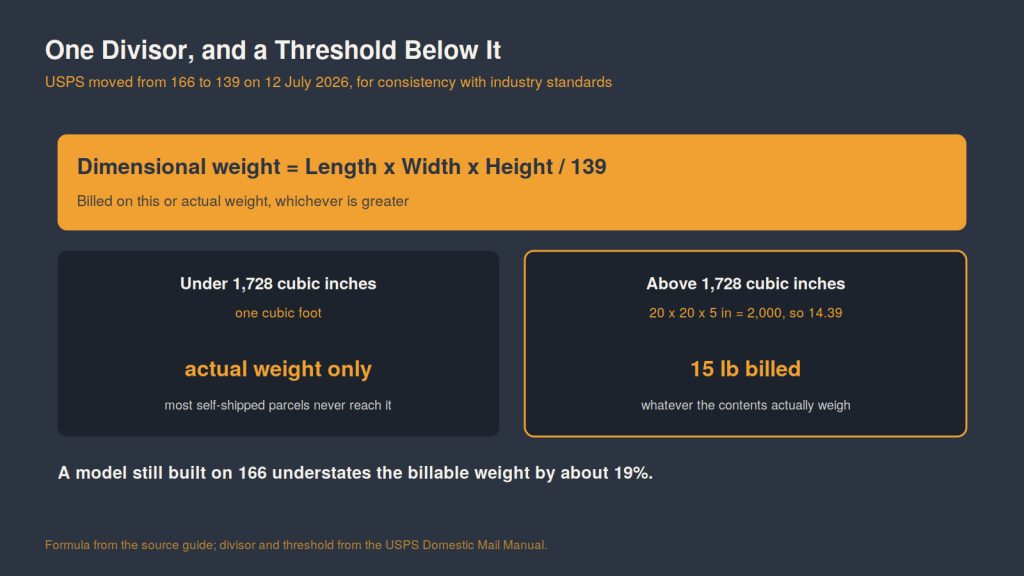
One divisor, and a threshold most self-shipped parcels never cross.
That is the population worth measuring. Everything under a cubic foot can be modeled on actual weight and forgotten.
Four Costs, Four Models
The word “shipping” covers four distinct expenses that behave differently and are frequently collapsed into one line.
Supplier to your warehouse or port. Ocean or air freight, priced by container or by chargeable weight, and lumpy. This is the one that gets amortized badly, because it arrives as a single invoice for a lot of units.
Inbound to the fulfillment center. Per unit, and highly variable by method. Container freight can be $0.60 to $1.20 a unit. Express runs $3 to $5. That spread is larger than most people’s entire margin assumption, and the choice between them is usually made under time pressure at the worst moment.
FBA fulfillment. Charged by size tier and billed on the greater of actual or dimensional weight. Not something you negotiate. Something you design against.
Last-mile under FBM. Your carrier account, your zone mix, your problem, and the one that moves when fuel surcharges do.
Modeling these as one number produces a figure that is wrong in a direction you cannot diagnose, because you cannot tell which of the four moved.
Where Packaging Becomes a Pricing Decision
Three practical consequences follow, and all three are decided before you order inventory rather than after.
Bulky and extra-large products carry structural risk. Their fees scale with a dimension you cannot compress much, and a small design change can cross a tier boundary. The 2026 US size limits give you the edges to design against: small standard tops out at 15 by 12 by 0.75 inches and 16 ounces, large standard at 18 by 14 by 8 inches and 20 pounds.
Bundling cuts both ways. Two units in one carton raises the average order value and it also raises the dimensions, and if the bundle crosses a cubic foot or a size tier the fee increase can exceed the revenue increase. Model the bundle as a separate product, because that is what it is.
Small standard is a genuine structural advantage. Under a cubic foot, under the dimensional threshold, in the cheapest tier. Sellers hunting for an edge in fee structure will find more of it in product selection than in negotiation.
Measure the Carton, Not the Product
The single most common error in shipping models is entering the product’s dimensions rather than the shipping carton’s.
They are never the same. The carton includes the void fill, the wall thickness, and whatever the packer added because the first version arrived damaged. Dimensional weight is computed on the outer carton, so that is the object to measure, and it should be measured after the packaging is final rather than during design.
Round up, as the postal rule does. A 17.6 inch measurement is an 18 inch measurement for billing.
Run It Before the Purchase Order
The reason to do this work early is that almost none of it is fixable later.
You can change your price after launch. You can change your keywords, your images, your ad spend, and your fulfillment method. What you cannot easily change is the carton you have 3,000 units already packed into, and the carton is what the dimensional weight is computed from.
Twenty minutes with a tape measure and a calculator, before the purchase order goes out, is the highest-return time available in this whole exercise.
About the Author